Hudu 2.45 is here: broader connections, faster documentation
This release extends where Hudu connects and speeds up how you document. Passkeys and three new integrations (Unifi, Endpoint Central, and Slide) widen what Hudu plugs into, while a rebuilt asset layout builder, custom QR labels, and a modern block-based editor make the day-to-day work of documenting faster.
Cloud environments begin updating today; self-hosted environments can update whenever they're ready.
Note: to use passkeys, you'll need Hudu Password Manager v1.1.0 alongside Hudu v2.45. Make sure both are updated before testing the feature.
Highlights
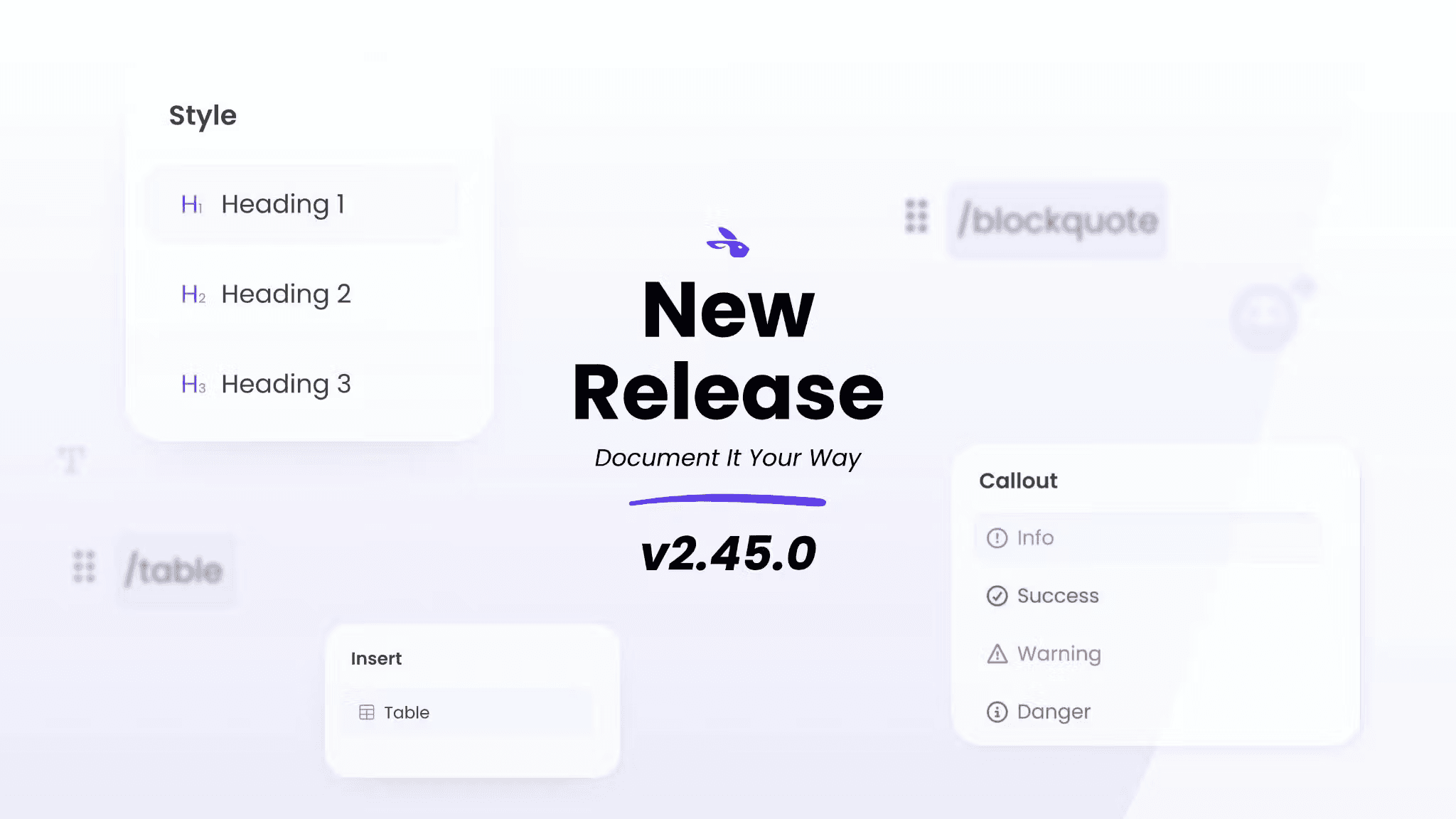
A modern, block-based editor
v2.45 block editor feature video
The KB editor and all rich text fields across Hudu now run on a new block-based editor powered by TipTap. It keeps everything the previous editor supported and adds drag-and-drop blocks, floating menus, and slash commands, plus markdown import and export (CommonMark/GFM and HTML) across every rich text field.
This is a game-changer for day-to-day documentation: enjoy faster documentation and the freedom to instantly migrate and paste your pre-formatted markdown straight into Hudu.
v2.45 import/export markdown feature video
Passkeys in Hudu Password Manager
v2.45 Passkeys feature video
Passwords aren't going away overnight, but passkeys are quickly becoming the safer default, and now your team can manage them right alongside everything else in Hudu. The Hudu Password Manager browser extension supports creating and storing both shared company passkeys and personal My Vault passkeys, so techs can add a passkey to an existing credential or create a new record from scratch.
For MSPs managing logins across dozens of client environments, this means one less place credentials live: passkeys sit next to the passwords and notes your team already documents in Hudu, instead of scattered across personal password managers or browser vaults.
Note: Hudu and Hudu Password Manager must be updated to use passkeys.
A rebuilt asset layout builder
v2.45 Asset Layout builder feature video
Asset layouts got a full overhaul, moving from a more rigid configuration screen to something that works like an actual form builder: drag and drop fields into place, preview the asset as you build it, and everything saves automatically as you go.
For anyone standardizing documentation across a growing client base, this cuts a lot of the back-and-forth out of designing a new layout: you see the result as you build it rather than guessing and previewing after the fact.
Three new integrations: Unifi, Endpoint Central, and Slide
This release also widens what Hudu connects to, with three new syncs:
Unifi OS: Hudu now syncs sites, devices, and networks directly from Unifi OS, automatically creating assets and networks in IPAM. It supports multiple Unifi connections and connected fields for device name, features, firmware status and version, interfaces, IP address, MAC address, model, and serial number. For MSPs running Unifi gear across client sites, this closes a documentation gap that used to mean manual entry: device and network details now stay current in Hudu without someone updating records by hand.
ManageEngine Endpoint Central: Company and device data from Endpoint Central now syncs into Hudu automatically, keeping endpoint records up to date without manual exports or imports.
Slide: Hudu now syncs devices, agents, and snapshots from Slide, bringing backup status and device data into the same place you document everything else about a client.
Custom QR labels
Asset layout QR labels are now fully configurable: add extra asset info, custom text, and reorder fields to fit how your team actually labels equipment on-site. Like the layout builder, changes preview live and save automatically.
If you print labels for client hardware, this means the label can finally match the workflow: pull in the fields your techs actually need to see at a glance, in the order that makes sense, without settling for a generic default.
Improvements
Alerts
- Alerts can now be scoped to one or more companies
- Record change alerts can be scoped to a specific asset layout
- Expiration alerts can be scoped to specific field expiration types
- Webhook variables (RECORD_ID, RECORD_TYPE, COMPANY_NAME, COMPANY_ID, HUDU_COMPANY_URL) now also work on Single Expiration, Website Monitor, and Password View alerts
- A new USER webhook variable is available on all alerts
Integrations
- Added support for NinjaOne's FedRAMP API endpoint
- Added the ability to skip syncing devices by device type in NinjaOne
- Added the ability to select custom Halo fields as asset names when importing devices
- Optimized the Addigy company sync
- Auvik tenant display-name changes now propagate into already-matched companies
- Added a configurable Hudu attribution mode for Halo KB article sync: show it on the article body, move it into Halo internal notes, or turn it off
- Refreshed descriptions on integration cards
Security and access
- An active Hudu web session is now required to use Hudu Assist and/or Hudu Password Manager
Activity and search
- Activity logs now name the specific API key, integration, import, or job that made a change, instead of attributing everything to HuduBot
- Added resource type filtering to the activity logs API endpoint
- The Flag directory has been redesigned with cards instead of a table, a bulk-action toolbar for deleting, and the ability to sort cards
- The Admin/Users directory now supports filtering and sorting by role, plus a new sortable "last login" column
Fixes
- Fixed duplicate alert emails being sent out
- Fixed an issue in the Assets API update flow where custom field updates could persist even when the overall request failed
- Fixed sorting by an empty column still affecting ordering
- Fixed the ConnectWise integration stacking multiple cards onto a single asset
- Fixed archiving a company not archiving its Photos, VLANs, VLAN Zones, and Racks
Self-hosted: plan ahead for v2.46
The next major release, v2.46, will ship a feature that requires Postgres 18+ with pgvector. If you're self-hosted, start planning that upgrade now.
Minimum suggested versions for self-hosted environments:
- Postgres: 18.6 with pgvector
- Redis: 7.2.4-alpine
- Nginx: 1.31.2