
Meet Precision IT
Precision IT is an Australian MSP supporting 200+ clients. Technical Operations Lead Mark Holden needed more than a documentation tool — he needed a live data layer that could keep pace with an automation-first operations model across complex multi-cloud and on-premises environments. After their previous solution became a bottleneck, Precision IT moved to self-hosted Hudu.
- Location: Australia
- Business type: MSP
- Customer since: 2024
- Website: precisionit.com.au
Why did you switch to Hudu?
Previous solution had become a bottleneck — slow, unreliable, and impossible to build on
- Previous platform was consistently slow to load and navigate, adding friction to every ticket
- Integration sync failures and stale data meant engineers couldn't trust what they were seeing without cross-referencing the source system
- The platform hadn't kept pace with the tooling we'd standardized on and lacked the depth of native integration support we needed
- We weren't just looking for a documentation platform anymore — we needed something that could act as a live data layer alongside our PSA and RMM
How are you using Hudu?
Hudu has become the central documentation and operational data layer for our business, sitting alongside our PSA and RMM as one of our core platforms. We lean heavily on the integration ecosystem to keep documentation current without manual effort. The result is documentation that reflects reality rather than a snapshot from the last manual update.
The platform serves two audiences for us. Internally it's where our engineers go for runbooks, standard configurations, troubleshooting guides, and platform-specific knowledge. Client-facing documentation captures the environment-specific information our team needs at the point of work, including network diagrams, credentials, application details, and procedural documentation tailored per client.
Our use of Hudu has evolved significantly over time. We started with it as a like-for-like replacement for our previous documentation platform, but it's expanded into our internal knowledge base, our risk management surface, and increasingly an automation target — workflows now read from and write to Hudu as part of broader operational pipelines.
Asset management & linking
Hudu's asset types and interlinking capabilities are the foundation of Precision IT's documentation structure. Assets are searchable, linkable to affected infrastructure, and visible to anyone working in a client's documentation — making browsing through Hudu as fast and intuitive as possible for the team.
API & automation
Hudu's flexible asset types and open API are the foundation of Precision IT's automation-first model. Mark's team has built workflows that programmatically create and update assets, reconcile data across platforms, and surface inconsistencies that would otherwise only be caught in manual audits. They've also used custom assets and the API to build automated client Risk Registers — end-of-life hardware, expiring certificates, and software past end-of-support are all identified and written back to Hudu automatically, linked to the affected infrastructure and visible to anyone working in that client's documentation.
Knowledge base
Hudu's Knowledge Base serves as Precision IT's central home for runbooks, SOPs, firewall standards, automation workflow patterns, and infrastructure-as-code documentation. The team has standardised on a consistent semantic format for all KB articles to keep the knowledge base structured and genuinely usable when engineers are working under pressure.
Integrations
Hudu connects Precision IT's full stack — NinjaOne, HaloPSA, Liongard, Cloudflare, Intune, MapBox, and UniFi — into a single source of truth, with the API filling any remaining gaps. Asset and configuration data flows in automatically so what the team sees reflects what's actually deployed.
Hudu Assist
Hudu Assist surfaces documentation directly inside HaloPSA and NinjaOne, so engineers can access client context without leaving the tools they're already working in — reducing context switching during active tickets.
Self-hosted deployment
For Precision IT, self-hosting was not just a preference. It supported stronger control over sensitive client documentation, infrastructure data, credentials, and operational workflows, while allowing the team to align the platform with its own security and governance expectations.
What's improved since switching?
Documentation as a live operational dataset — not a static reference
The shift to Hudu has changed documentation from a reference layer the team tolerated into an active operational tool they rely on.
- Documentation now reflects reality rather than a snapshot from the last manual update
- Engineers use documentation as a first port of call rather than a last resort
- Risk Registers are visible, current, and programmatically maintained — no more quarterly spreadsheet reviews
- Inconsistencies between systems surface automatically rather than waiting for manual audits
- A single source of truth across client environments, internal processes, and risk management
Before Hudu: documentation was often treated as something to check only after confirming the source system.
After Hudu: engineers now use documentation as the first port of call because it is current, linked, searchable, and integrated into the tools they already use.
With that, Precision IT has:
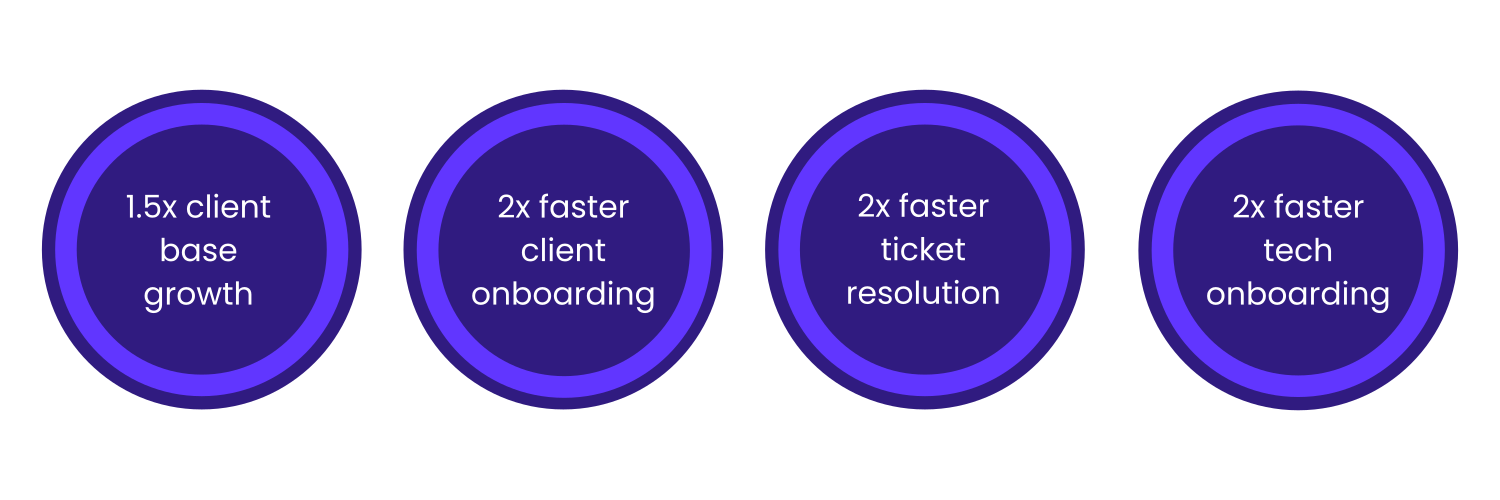
- Improved ticket resolution speed by 2x
- Improved client onboarding speed by 2x
- Improved new technician onboarding speed by 2x
- Grown their client base by up to 1.5x
- Grown their team headcount
What do you like most about Hudu?
An API that makes Hudu a platform you build on, not just store information in
- Very big fan of the API integration — if we can automate something and do it at scale, we will
- The way assets work and can interlink with each other makes browsing through Hudu as easy as possible for the team
- Fast, genuinely useful integrations out of the box
- A platform that scales with the business rather than becoming a bottleneck